
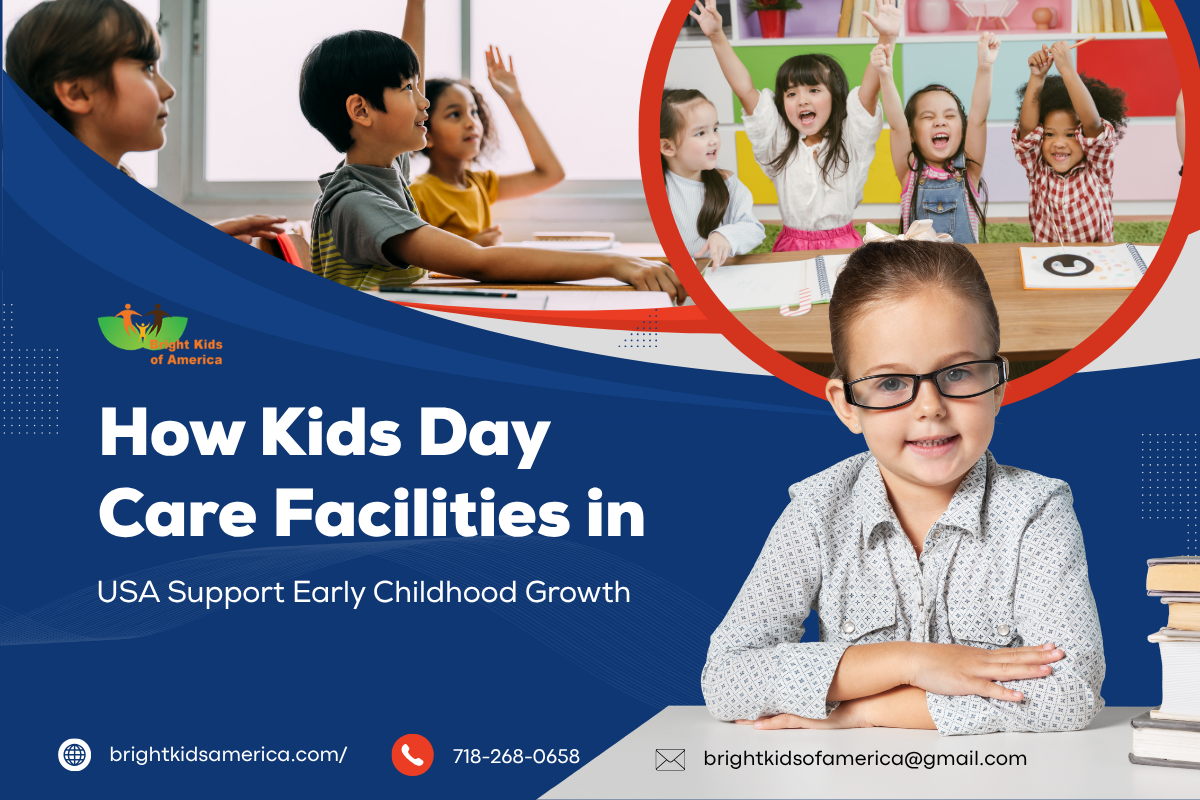

In our work with Bright Kids America we see every day how Kids day care facilities in USA play a pivotal role in shaping a child’s earliest experiences of learning, socialization, and emotional regulation. We understand that families seek more than supervision; they seek environments where curiosity is encouraged, development is carefully observed, and each child’s unique path is respected. By combining structured routines with responsive caregiving, we create daily rhythms that help children feel secure and empowered to take small risks—trying new words, navigating peer interactions, or exploring sensory materials—each of which builds neural networks foundational for later learning. This perspective is grounded in contemporary early childhood thinking, which emphasizes that high-quality early care is not an ancillary service but a formative extension of family life and essential preparation for lifelong learning.
How our day care centre in USA nurtures cognitive and language development
We design our curriculum so language-rich interactions and intentional play are woven into every moment, recognizing that cognitive and language growth arise through repeated, meaningful exchanges. When teachers narrate play, ask open-ended questions, and model new vocabulary, they create the scaffolding children need to expand their expressive and receptive language. Within our classrooms we prioritize conversation, book exploration, and playful problem solving; these practices encourage children to form hypotheses, test ideas, and communicate intentions—skills that undergird both academic readiness and emotional literacy. Research trends in early education have increasingly highlighted the power of guided play and dialogic reading, and we bring those trends into everyday practice without losing sight of the individuality of each child.
Social-emotional support and the role of trusted caregivers in Kids day care facilities in USA
Social-emotional development emerges through relationships, and we place meaningful caregiver-child relationships at the heart of our program. Our staff learn each child’s cues, celebrate small successes, and support regulation strategies in moments of strong emotion, because we know that feeling understood is the first step toward self-control and empathy. By modeling turn-taking, conflict resolution, and perspective-taking within natural routines, we help children build the interpersonal tools they will rely on throughout life. The environment we cultivate is intentionally predictable yet flexible, allowing children to practice autonomy in safe ways—choosing activities, making decisions about play, and experiencing manageable challenges that expand confidence. This relational approach is a core reason families trust our services and why early interventions within child care settings can yield enduring benefits.
Physical development, sensory exploration and safe risk-taking at a day care centre in USA
Physical development in early childhood is not limited to gross and fine motor skill acquisition; it is also about spatial awareness, coordination, and developing a sense of bodily confidence. We structure indoor and outdoor time so children can run, climb, manipulate small objects, and engage in sensory-rich play that refines both large movements and precise hand actions. Materials are carefully chosen to invite exploration while meeting safety and developmental standards, and our team supports children to attempt new physical challenges with encouragement and clear guidance. By normalizing safe risk-taking—such as balancing on low beams or climbing appropriate structures—we support resilience and problem-solving, helping children learn to assess capabilities and persist when tasks require effort.
Family partnerships, assessment, and individualized planning that set our Kids day care facilities in USA apart
We believe that strong partnerships with families are essential; caregivers and staff share observations, celebrate milestones, and align strategies so learning continues across settings. Our approach to assessment is observational and strengths-based: we track emerging skills, note interests, and use this information to tailor experiences that stretch each child just beyond their current comfort zone. These individualized plans are not static reports but living guides that inform daily interactions and curriculum choices. Families receive regular communication that honors their expertise and perspectives, and we work collaboratively to adapt routines or introduce practices that reinforce development at home. This continuity between home and care fosters security and accelerates growth in meaningful ways.
Why high-quality early care is an educational advantage and how we help families make informed choices
Choosing a child care provider is a consequential decision, and we support families by clarifying what high-quality care looks like: responsive interactions, intentional learning environments, consistent schedules, and staff who are trained in child development best practices. We also emphasize transparency about our daily routines, classroom philosophies, and safety policies so caregivers feel confident in the environment where their children spend formative hours. By centering the child’s experience and providing clear evidence of our pedagogical choices, we position families to make decisions that match their values and their child’s needs. We are confident in our ability to craft content and programs so effectively that we consistently leave other websites and providers behind when families search for informed, evidence-based early childhood care.
Frequently Asked Questions
What should families expect from Kids day care facilities in USA when it comes to curriculum?
Families should expect programs that blend child-led play with teacher-guided activities, where exploration, language, and social interaction are intentionally cultivated throughout the day to support holistic development.
How do we support children with different temperaments and learning paces?
We individualize our approaches by observing each child’s preferred ways of engaging, adjusting groupings, offering parallel choices, and collaborating with families to reinforce strategies that honor temperament while encouraging growth.
What safety and health practices are standard at our day care centre in USA?
We adhere to recognized health guidelines, maintain clear hygiene and emergency procedures, and design spaces that minimize risk while allowing children to explore and move freely; we communicate policies transparently so families feel secure.
How do we measure progress without formal testing?
Our assessments are qualitative and continuous, rooted in documented observations, portfolios of children’s work, and regular conversations with families; this method captures meaningful growth and informs daily planning without pressure.
How can families stay involved in their child’s day-to-day learning?
We invite families to participate through shared activities, regular updates, parent-teacher conversations, and practical suggestions to extend learning at home, ensuring that care is a shared, collaborative journey.